
Super User

“The City of Mosaics”
Just 30 km from Amman, along the 5,000-year-old Kings´ Highway, is one of the most memorable places in the Holy Land. After passing through a string of ancient sites, the first city you reach is Madaba, known as the “City of Mosaics.”
Best known for its spectacular Byzantine and Umayyad mosaics, Madaba is home to the famous 6th century Mosaic Map of Jerusalem and the Holy Land. With two million pieces of vividly colored local stone, it depicts hills and valleys, villages and towns as far as the Nile Delta.
The Madaba Mosaic Map covers the floor of the Greek Orthodox Church of St. George, which is located northwest of the city center. The church was built in 1896 AD, over the remains of a much earlier 6th century Byzantine church. The mosaic panel enclosing the Map was originally around 15.6 X 6m, 94 sq.m., only about a quarter of which is preserved.
Other mosaic masterpieces found in the Church of the Virgin and the Apostles and in the Archaeological Museum depict a rampant profusion of flowers and plants, birds and fish, animals and exotic beasts, as well as scenes from mythology and the everyday pursuits of hunting, fishing and farming. Literally, hundreds of other mosaics from the 5th through the 7th centuries are scattered throughout Madaba’s churches and homes.
In line with Jordan’s commitment to restoring and preserving its mosaic masterpieces, Madaba’s extensive Archaelogical Park & Museum complex encompasses the remains of several Byzantine churches, including the outstanding mosaics of the Church of the Virgin and the Hyppolytus Hall, part of a 6th century mansion.
Close to the Church of the Virgin is the Madaba Institute for Mosaic Art and Restoration, which operates under the patronage of the Ministry of Tourism. The only project of its kind in the Middle East, the Institute trains artisans in the art of making, repairing and restoring mosaics.
HISTORY & CULTURE
Madaba is an ancient town of the Jordanian Plateau, which was resettled by Christian Arab tribes from the Karak region in 1880 A.D. It is now inhabited by Christians and Muslims alike. A great deal of antiquity has been found here, much of which can now to be seen in the Museum and in Archaeological Parks.
Modern Madaba is built on an artificial mound which conceals the remains of much earlier sites. The town has a long history, being first mentioned in the Bible at the time of Exodus, about 1200 BC. A tomb of this period has been found in the east of the town.
By Maccabaean times (c.165 BC) it had been re-occupied by the Ammonites, but in around 110 BC it was taken, after a long siege, by John Hyrcanus. It remained in Jewish hands until the time of Alexander Jannaeus, and was one of the towns promised to Aretas, king of the Nabataeans, if he helped Hyrcanus II to recover Jerusalem.
The Romans made it a typical provincial town, with colonnaded streets, fine temples and other buildings, large water cisterns and a town wall. The town continued to flourish throughout the 8th century and beyond. As the date of the mosaic floor in the church is 767 AD traces of the Roman town can be seen in the long stretches of the paved street in Madaba’s Archaelogical Park.
The Madaba Mosaic Map covers the floor of the Greek Orthodox Church of St. George, which is located northwest of the city centre. The church was built in 1896 AD, over the remains of a much earlier 6th century Byzantine church. The mosaic panel enclosing the Map was originally around 15.6 X 6m, 94 square meters, only about a quarter of which is preserved.
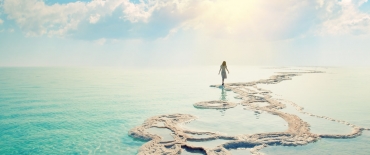
“Nature’s living miracle”
Without a doubt the world’s most amazing place, the Jordan Rift Valley is a dramatic, beautiful landscape, which at the Dead Sea, is over 400 m (1,312 ft.) below sea level. The lowest point on the face of the Earth, this vast stretch of water receives a number of incoming rivers, including the River Jordan. Once the waters reach the Dead Sea they are land-locked and have nowhere to go, so they evaporate, leaving behind a dense, rich, cocktail of salts and minerals that supply industry, agriculture and medicine with some of its finest products
The Dead Sea is flanked by mountains to the east and the rolling hills of Jerusalem to the west, giving it an almost other-worldly beauty. Although sparsely populated and serenely quiet now, the area is believed to have been home to 5 Biblical cities: Sodom, Gomorrah, Adman, Zebouin and Zoar (Bela).
One of the most spectacular natural and spiritual landscapes in the world, the Jordanian east coast of the Dead Sea has evolved into a major hub of both religious and health & wellness tourism in the region. A series of good roads, excellent hotels with spa and fitness facilities, as well as archaeological and spiritual discoveries make this region as enticing to today’s international visitors as it was to kings, emperors, traders, prophets and pilgrims in antiquity.
The leading attraction at the Dead Sea is the warm, soothing, super salty water itself – some 10 times saltier than sea water, and rich in chloride salts of magnesium, sodium, potassium, bromine and several others. The unusually warm, incredibly buoyant and mineral-rich waters have attracted visitors since ancient times, including King Herod the Great and the beautiful Egyptian Queen, Cleopatra. All of whom have luxuriated in the Dead Sea’s rich, black, stimulating mud and floated effortlessly on their backs while soaking up the water’s healthy minerals along with the gently diffused rays of the Jordanian sun.
Amman Touristic Beach
Situated on the Dead Sea main road, 2 kilometers after the hotels area, Amman Touristic Beach offers swimming pools and changing rooms for low budget travelers and locals for minimal fees. Amman Touristic Beach is an ideal location for beach parties and events.
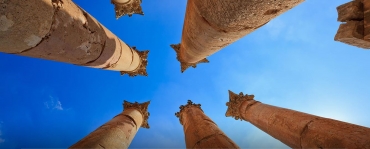
“A Rome away from Rome”
A close second to Petra on the list of favorite destinations in Jordan is the ancient city of Jerash, which boasts an unbroken chain of human occupation dating back more than 6,500 years.
Jerash lies on a plain, surrounded by hilly wooded areas and fertile basins. Conquered by General Pompey in 63 BC, it came under Roman rule and was one of the 10 great Roman cities of the Decapolis League.
The city’s golden age came under Roman rule, during which time it was known as Gerasa, and the site is now generally acknowledged to be one of the best-preserved Roman provincial towns in the world. Hidden for centuries in sand before being excavated and restored over the past 70 years, Jerash reveals a fine example of the grand, formal provincial Roman urbanism that is found throughout the Middle East, comprising paved and colonnaded streets, soaring hilltop temples, handsome theaters, spacious public squares and plazas, baths, fountains and city walls pierced by towers and gates.
Beneath its external Greco-Roman veneer, Jerash also preserves a subtle blend of East and West. Its architecture, religion and languages reflect a process by which 2 powerful cultures meshed and coexisted – The Greco-Roman world of the Mediterranean basin and the traditions of the Arab Orient.
The modern city of Jerash can be found to the east of the ruins, while the old and new share a city wall, careful preservation and planning has seen the city itself develop well away from the ruins so there is no encroachment on the sites of old.
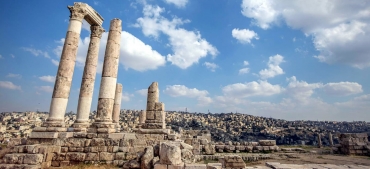
“A modern city, built on the sands of time…”
Jordan’s capital Amman – is a city of contrasts, a mixture of ancient and modern, where many civilizations left their mark. Originally Amman was built on 7 hills, but now it spreads over at least 19 hills.
The oldest records refer to Amman as Rabbath-Ammon, the capital of the Ammonite Kingdom. Later on it was called Philadelphia and around 30 BC it became part of the Roman Empire. At that time it was a member of the Decapolis, the famous league of 10 cities that were bound by powerful commercial, political and cultural interests.
Nowadays you can still see many remains from ancient times. The Amman Citadel features a lovely view over the hills and valleys of the capital. You may visit the remains of the temple of Hercules, the Ummayyad Palace, a Byzantine Church and the Archaeological Museum. Down the hill you may visit the Roman Theatre which seats 6,000 and the nearby Grand Husseini Mosque.
Modern Amman also has a lot of entertainment to offer. In the commercial heart of the city, ultra-modern buildings, hotels, smart restaurants, art galleries and boutiques rub shoulders comfortably with traditional coffee shops and tiny artisans’ workshops. Enjoy the taste of Arabic coffee and sweets. Taste the Arabic food in one of the nice restaurants, accompanied by traditional life music. Everywhere there is evidence of the city’s much older past.
Due to the city’s modern-day prosperity and temperate climate, almost half of Jordan’s population is concentrated in the Amman area. The residential suburbs consist of mainly tree-lined streets and avenues flanked by elegant, almost uniformly white houses in accordance with a municipal law, which states that all buildings must be faced with local stone.
The downtown area is much older and more traditional with smaller businesses producing and selling everything from fabulous jewelry to everyday household items.
The people of Amman are multi-cultural, multi-denominational, well-educated and extremely hospitable. They welcome visitors and take pride in showing them around their fascinating and vibrant city.